

SMS Gateway vs SMS API: Key Differences Explained
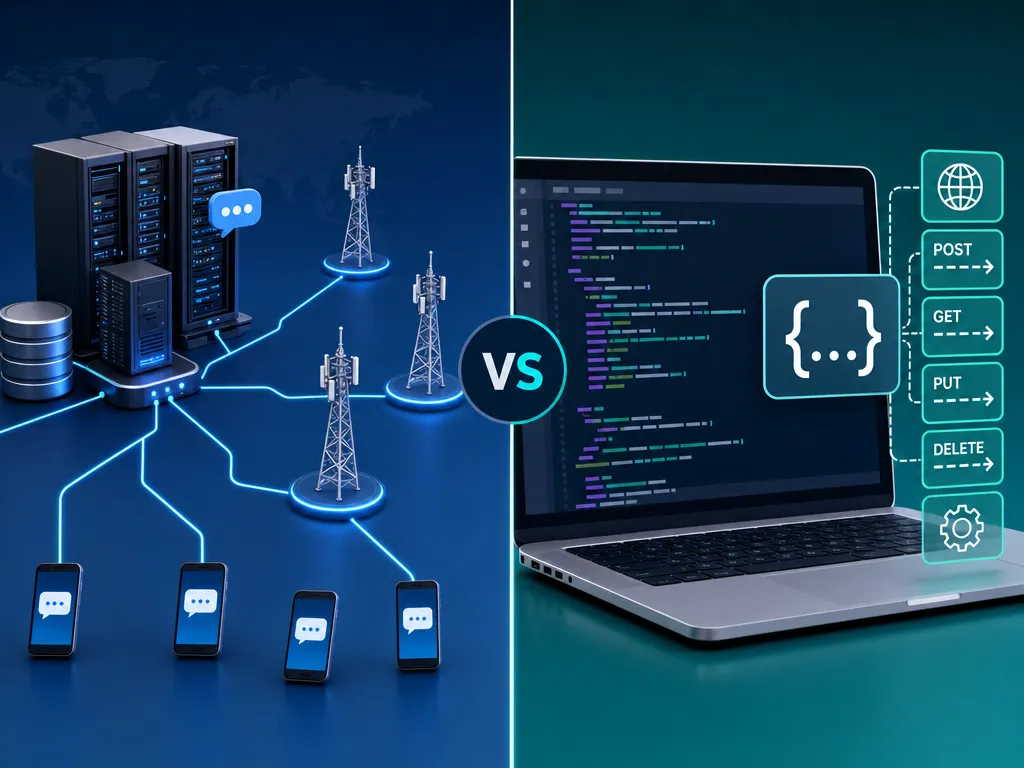
SMS Gateway vs SMS API: Key Differences Explained
If you are building an app that sends verification codes, alerts, or notifications, you have probably run into two terms: SMS gateway and SMS API. They sound similar. People use them interchangeably. But they describe different layers of the same job, and knowing the difference helps you pick the right tool.
This guide breaks down what each one actually is, how they connect, and how to decide which approach fits your project.

What Is an SMS Gateway?
An SMS gateway is the infrastructure that moves a message between the internet and mobile carrier networks. Think of it as a translator and router. Your software speaks in web protocols. Mobile carriers speak in telecom protocols like SMPP. The gateway sits in the middle and converts one into the other.
When you send a text through a service, the message travels through a gateway before it ever reaches a phone. The gateway decides which carrier route to use, handles delivery to the destination network, and sends back status reports.
A gateway handles the heavy lifting most developers never want to touch:
- Connecting to carrier networks worldwide
- Managing routes for reliability and cost
- Handling delivery receipts and retries
- Converting between message formats
In short, the gateway is the plumbing. It is the physical and logical path a message follows.
What Is an SMS API?
An SMS API is the interface your code talks to. API stands for application programming interface. It is a set of endpoints, usually REST-based, that lets your application request an action with a simple HTTP call.
You send a POST request with a destination number and a message body. The API responds with a message ID and a status. Behind that response, the provider's gateway does the actual sending.
So the API is how you ask. The gateway is how it gets done.
Here is a simplified example of what an API call looks like:
POST /v1/messages
{
  "to": "+15551234567",
  "text": "Your code is 483920"
}
That is it. You do not manage carrier connections, routing tables, or telecom protocols. The API hides all of that behind clean, documented endpoints. Modern providers publish full developer documentation so you can integrate in minutes rather than weeks.
The Core Difference in One Sentence
An SMS API is the doorway. An SMS gateway is the road behind it.
You almost never buy a gateway on its own today unless you are a large enterprise or a telecom operator. Instead, you use an API, and the provider runs the gateway for you. The API is the modern, developer-friendly layer that sits on top of gateway infrastructure.

Gateway vs API: A Side-by-Side Comparison
| Aspect | SMS Gateway | SMS API |
|---|---|---|
| What it is | Infrastructure that connects to carriers | Software interface for developers |
| Protocol | Telecom protocols (SMPP, SS7) | HTTP / REST |
| Who uses it | Telecom operators, large enterprises | Developers, apps, SaaS teams |
| Setup effort | High, needs telecom expertise | Low, integrate in minutes |
| Maintenance | You manage routes and uptime | Provider handles it |
| Best for | Massive volume, full control | Fast integration, verification, alerts |
When Would You Use a Raw SMS Gateway?
Direct gateway access makes sense in a few specific situations:
- You are a telecom operator. You run your own carrier relationships and need SMPP-level control.
- You send enormous volume. At millions of messages per day, negotiating direct routes can lower per-message cost.
- You need custom routing logic. Some businesses build their own routing engines for regulatory or performance reasons.
For everyone else, raw gateway access adds complexity without much benefit. You would need engineers who understand SMPP, binding sessions, throughput windows, and carrier negotiations. That is a big investment.
When Should You Use an SMS API?
For most applications, an API is the right choice. It fits when you want to:
- Send one-time passwords and verification codes
- Deliver appointment reminders or shipping alerts
- Trigger transactional messages from your backend
- Scale without hiring a telecom team
Because the API abstracts the gateway, you get reliability, routing, and delivery reports without touching the underlying network. This is why nearly every startup and SaaS product today integrates an SMS API rather than building gateway infrastructure. If you want a deeper technical walkthrough, our SMS verification API developer guide covers the full integration flow.
Sending vs Receiving: An Important Distinction
Most SMS gateways and APIs focus on sending messages outbound. But many use cases involve receiving messages, especially verification codes.
When you sign up for WhatsApp, Telegram, or Google, those platforms send an SMS to a number you control. To receive that code, you need a number and a way to read the incoming message programmatically.
This is where receiving APIs come in. Instead of sending outbound, you rent a number and poll an endpoint for the incoming code. SMSBulk built its platform around exactly this need. You can grab a virtual number for SMS verification from countries worldwide and read the code through a clean API, without operating any gateway yourself.
The same REST-style approach applies whether you send or receive. You call an endpoint, you get a structured response. The gateway complexity stays hidden.
How SMSBulk Fits Into the Picture
SMSBulk sits on the API side of this comparison. You do not manage carrier routes or telecom protocols. You call documented endpoints and get results.
The platform covers three connected products under one account and wallet:
- SMS verification numbers to receive codes for WhatsApp, Telegram, Google, Instagram, and many other services.
- An email verification API that mirrors the SMS API for validating email addresses.
- Travel eSIMs for data in 200+ destinations, delivered by QR or iOS direct install.
The API approach means you integrate once and scale as needed. If you run a SaaS product, our guide on SMS verification for SaaS shows how to wire verification into signup and login flows.
Reliability and Delivery: Why It Matters
Whichever layer you touch, delivery quality depends on routing underneath. A poorly routed message may arrive late, arrive garbled, or never arrive at all. This is a common frustration with cheap or shared setups.
Good API providers maintain multiple carrier routes and switch automatically when one fails. This failover logic is invisible to you as a developer, but it is the reason a well-run API feels reliable. If you want to understand how redundancy works at the API level, our article on SMS verification with provider failover explains the pattern in detail.
The lesson is simple. When you choose an API, you are also choosing the gateway infrastructure behind it. Evaluate delivery rates and country coverage, not just the price per message.
Common Questions
Is an SMS gateway the same as an SMS API?
No. A gateway is the infrastructure that connects to carriers. An API is the interface your code uses to reach that infrastructure. They work together, but they are different layers.
Do I need both?
In practice, you use an API and the provider supplies the gateway. You rarely interact with a gateway directly unless you are a telecom-scale operation.
Which is cheaper?
An API is cheaper to start with because there is no infrastructure to build. Direct gateway access can lower per-message cost at massive volume, but the setup and staffing costs are high.
Can an SMS API both send and receive?
Yes. Some APIs focus on outbound sending. Others, like SMSBulk, specialize in receiving verification codes on rented numbers. Choose based on your use case.
What protocol does a gateway use?
Gateways typically use SMPP to talk to carriers. APIs use HTTP and REST, which is why they are far easier for developers to adopt.
Which One Should You Choose?
For almost every modern project, the answer is an SMS API. It gives you carrier-grade delivery without the telecom overhead. You integrate in a day, not a quarter, and you let the provider handle routes, retries, and uptime.
Reserve raw gateway access for cases where you have telecom expertise, enormous volume, and a real business reason for custom routing. Everyone else is better served by a clean, well-documented API.
Get Started with SMSBulk
Ready to move from theory to code? SMSBulk gives you an API-first platform for receiving SMS verification codes, validating emails, and getting travel data eSIMs, all under one account and wallet. Skip the gateway complexity, grab a virtual number in minutes, and start reading verification codes through a clean REST endpoint. Head to our SMS verification service or explore the pricing to see how affordable it is to get started today.
Готовы легко верифицировать аккаунты?
Получайте коды подтверждения по SMS из 190+ стран, а если ничего не пришло, средства автоматически вернутся на баланс.